Thursday, June 18, 2009

Fulfilling Dual Roles - Is Socializing with Students Acceptable?

How would you respond to this invitation: “Professor, our cohort is going out for dinner and a few drinks to celebrate the end of another class. We would love it if you would join us.”


To complicate it, let’s assume that you really connected – personally and intellectually --with this group of adults over the course of eight weeks. Plus you’re down-right famished and just a little bit dry. Being that the invitation is an offshoot of your professional relationship with your students, must you look beyond hunger or thirst levels as the rationale for your choice?


Situations like these force adjuncts to consider the ethical boundaries, not always drawn with bright lines, of interaction with students outside of the classroom. You can find the horns of a dilemma here. Research shows that interacting with instructors outside the classroom can positively benefit a student socially and academically (see the prior entry on emotional intelligence in the classroom). At the same time, by socializing with students, the instructor might enjoy a power differential, risk losing objectivity, and undermine the professional nature of the relationship. (Rupert at 662).


With those competing interests in mind, what are your available options?


Does the fact that this is an adult program alter the equation? Does the timing of the invite – after the course rather than during it – matter? What if the request came from a single student rather than the whole class?


There is some interesting research on the contours of the professor-student relationship. Click here for an article in the Journal of Higher Education that explores “dual relationships” in higher education. Click here for an article using short case studies to consider ethical issues facing college professors (including social invites). And finally, click here for an offbeat article about an instructor who hosts colleagues and students at his home bar. What do you think about that?


Please feel free to share your thoughts in the comments section.


Reference: Rupert, Patricia A. and Holmes, Deborah L., Dual relationships in higher education. Journal of Higher Education; Nov/Dec97, Vol. 68 Issue 6, p660-678.


Tuesday, June 9, 2009

Mark Burgess wins Adjunct Award

Congratulations to Mark Burgess (pictured, left) for earning the 2009 Joel A. Kobert Distinguished Teaching Award, which is "presented annually to outstanding [Centenary College] adjunct faculty members in recognition of their excellence in teaching."

That accomplishment was recognized at the May Commencement ceremony (to the surprise of Mark, who, as I understand it, contentedly attended the ceremony thinking he was just a spectator). To me this is pleasing news, but certainly not surprising.

The official and unofficial feedback depicts Mark as a student favorite who knows how to animate his classes by tapping into real-world experience. That real world experience is not in short supply -- Mark is the Director of Marketing at Spectrotel, Inc. and responsible for all marketing and e-commerce activity.

Most importantly, perhaps, students frequently report that they are taking what they learn in his class…and using it. That's high praise in an adult business program.

To honor Mark's accomplishment, I decided to set aside some cyberspace so that he could share with us his teaching philosophy. In response to my request, Mark graciously provided the response below. Take it away, Mark...

Anthony asked me to write a few words about my teaching philosophy at Centenary. Here is what I focus on for each course.

1) Intense preparation based on the existing course materials.

2) Create new content that works with the existing course materials, e.g., relevant presentations, cases, real-life examples, etc. Basically, make the subject as current as possible.

3) Involve the students in the class discussions. Group activities are great, too. Go online. Use the Web in class. Teach them things they can apply immediately at work (today and tomorrow).

4)Ask students what their expectations are at the beginning of the first class.

5) Based on their feedback, brainstorm ways to exceed their expectations.

6) At the end of each course, ask the students if their expectations were met. Listen. Learn. Live the marketing concept. Get feedback and apply what you have learned.

My primary goal is to make each student understand and love the subject (Marketing) and to make learning an enjoyable experience. If you follow these suggestions, your students will look forward to coming to class (so will you). I believe that our students are counting on the instructor to raise the bar of excellence. Centenary students deserve the best we can deliver. Be enthusiastic. Enjoy what you do. Have fun. To quote an old Army campaign slogan, as an instructor, be the best you can be.

Friday, June 5, 2009

Emotional Intelligence in the Classroom

In reading Richard Lyon's excellent book "Success Strategies for Adjunct Faculty", I was struck by a passage he wrote about the factors impacting student success and satisfaction:

"Another commonly cited factor, teacher's knowledge of subject, was found in another major study to be the ninth most important dimension in both student achievement and student satisfaction ratings. Among more significant factors were teacher's clarity, stimulation of interest, openness to opinions, and sensitivity to class progress -- each largely functions of emotional intelligence." (Lyons 17).

Juxtapose that with the following research finding from Vincent Tinto, a Syracuse University professor and expert on retention:

"The frequency and quality of contact with faculty, staff, and other students is an important independent predictor of student persistence. This is true for large and small, rural and urban, public and private, and 2-and 4-year colleges and universities. It is true for women as well as men, students of color and anglo students, and part-time and full-time students. Simply put, involvement matters, and at no point does it matter more than during the first year of college when student attachments are so tenuous and the pull of the institution so weak." (Tinto, p. 3).

If you accept these ideas, in tandem they seem to suggest that we cannot run a successful classroom on the lights of our subject matter expertise, alone. There is a true human element in the learning process. Making a human connection with the students requires us to come out from behind the podium, step away from the Power Point presentation, and get to know and empathize with our students.

Maybe in preparation for my next business law course, I’ll have to read Daniel Goleman’s “Emotional Intelligence” in addition to brushing up on torts and contracts

I’d be curious to know, do your experiences bear out the premises of those quotes?
References:
Lyons, Richard E., Success Strategies for Adjunct Faculty (2004)

Tinto, Vincent, Taking Student Retention Seriously (2006)

Friday, May 29, 2009

Creating an Assignment Link in Blackboard

An instructor asked me how to create a place in Blackboard where learners can electronically upload their assignments. When an Assignment link is used, the instructor can retrieve the assignment through the Grade Center, provide feedback, and return the paper and the rubric to the learner, also through the Grade Center. Considering the organizational value of the feature, I thought the question deserved a public answer.

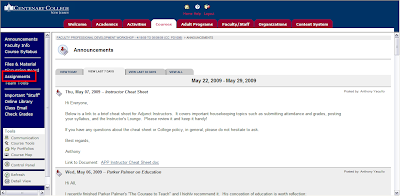
Step 1: From your course site, click the Assignment link on the left hand side of the page.


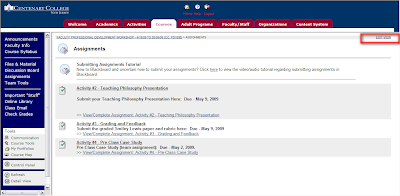
Step 2: Click “Edit View” at the top right hand side of the page


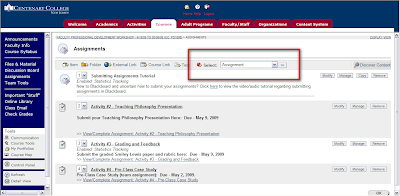
Step 3: Find the drop down menu next to the word “Select”, choose “Assignment”, and click “Go”


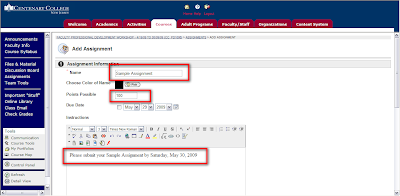
Step 4: Type in the desired attributes of the assignment. You can title the assignment, indicate the total point value, and provide and assignment description and due date. After entering this data, scroll to the bottom of the page and click “Submit”


This will automatically create (1) a link for learners under Assignments and (2) a column in your Grade Center for this specific Assignment. When learners submit it, you will see an exclamation point (!) in their row of the Grade Center.
For a printable version of these instructions, click here. The screen shots are much clearer in the Word format that is linked here.

Tuesday, May 19, 2009

Faculty Reception - A Debriefing

Last Thursday we held a reception in thanks of our adjunct faculty. After addresses by Dr. Joanne Cote-Bonnano and Dr. Deirdre Letson, my opening statement to the group was this: “We at faculty services want to do this more: get together, thank you for your hard work, tell you what’s new, and hear what is on your mind.” Not particularly profound, I know, but absolutely true.

Adjunct instructing does have some inherent drive-by qualities, but it should not be an anonymous or disjointed experience. Adjuncts are a crucial part of the College. For that reason, it was particularly nice to have adjuncts and faculty development staff in a room together, leisurely talking and sharing ideas.

We truly appreciated the questions that were raised and the input that was provided. I think two crucial channels of communication were opened further at the event: (1) adjunct-to-faculty services and (2) adjunct-to-adjunct. The more of that, the better.

I thought it might be helpful to recap, here, some of the updates that were provided:

First off, five goals have been established for faculty development:

1. Promote a learning-centered approach to instruction in both the online and face-to-face formats

2. Enhance adjunct understanding of College policy, procedure, and teaching resources.

3. Support the use of classroom technology in creating and delivering varied content.

4. Professionally develop adjunct faculty through the collection, analysis, and communication of assessment and evaluation data.

5. Foster a sense of community and support for adjunct faculty through an advising and mentoring program.

A variety of initiatives are in place or in the planning stage which align with these objectives. Below are some that were mentioned:

The APP Faculty Lounge: Shelly Nice is building a wonderfully informational, virtual place for adjunct resources. Currently, you can find there the syllabi for all of the eight-week, four credit courses plus the accompanying instructor manual and threaded discussion questions. This location also will house a calendar of events, teaching and learning resources, contact information, and policy and procedure. If there is specific information that you would like to see in the lounge, please let us know.

Adjunct Faculty Guide: Dr. Letson has compiled a “guidebook” for adjunct faculty members. The streamlined guidebook covers essential policies and procedures impacting adjunct performance. The guide currently is under review and will be made available soon. Stay tuned! In the meantime you might check out this Instructor Cheat Sheet.

Feedback: The End-of-Course survey program has returned. At the end of each course, the cohort Program Advisor will provide you with a packet of surveys to distribute to your class. The data is aggregated by an outside company and then reviewed by our evaluation expert, Dan Lane. Dan will summarize the results in narrative form and provide you with a hard copy.

In addition, Shelley Kurland continues to expertly run the Observation program, where each instructor is observed in the classroom at least once per year. After each observation you will have an opportunity to speak with the observer and receive written notes.

To best use that feedback, I welcome the opportunity to sit down with you, review the observation and/or survey notes, and think about how you can incorporate that information into your professional development plan.

Workshops: New instructors are required to take two workshops (1) Instructional Techniques I – a face-to-face, three hour workshop facilitated by Shelley Kurland (this workshop always receives positive feedback), and (2) Online Introduction – an online, three-week workshop covering topics such as adult learning theory, student-centered learning, team management, facilitation, and feedback. If you are interested in participating in either workshop (it is not limited to new instructors), please let me know.

Blog: You already know about the blog…because you are reading it right now. I envision this as a place to discuss important teaching and learning ideas, keep you abreast of College happenings, and highlight the good work that adjuncts are doing. Please feel free to comment on entries that strike your interest (just click “comment” at the end of the post and type away) and enroll as a “follower” of the blog.

Mentoring: We are designing a program that would pair adjuncts with a mentor who teaches in the same subject area. This program likely will start with accounting and math, and hopefully grow from there. More details to follow in the near future.

Thanks again to all who attended the reception. As always, please let us know if you have any ideas or comments as to where we can head, together, as a community of adjunct instructors.

Wednesday, May 6, 2009

Jim Samuel Hosts a Virtual Business Meeting


Last week, an adjunct instructor asked me a good question: If I were teaching a swimming class, would I prefer as my workspace a dry classroom or a wet pool?

The questioner was Jim Samuel (left), a Centenary adjunct who teaches, among other courses, Global Business, and we were discussing Jim’s use of technology in his class. As Jim points out, mastering global business requires more than memorizing culturally appropriate greetings and time zones. Global business coordination requires technological command and fluency in the virtual environment.

Jim easily could have taught his students about the virtual business environment in classroom Room 8 on the Parsippany campus. Or, perhaps, he could broach the topic while functioning, appropriately enough, in the virtual environment. Jim chose the latter. You see, he would teach swimming in a pool.

For his lesson on the virtual environment, Jim coordinated and ran an entire class, virtually, with all participants remote. How he did it is worth considering because it was an exemplar of careful planning and authentic learning.

The class first was provided with substantive content on virtual business communication. Teams were formed and charged with critiquing the content and creating a PowerPoint that communicated their views. One rub: to simulate the remote teamwork that is characteristic of global business, team members could not collaborate face-to-face. Instead, they “met” using a blog and other electronic means. Final presentations were to be made virtually, during a real-time, web conference with the entire class.

To organize logistics for the “conference,” Jim used an open-source tool called Meeting Wizard. This tool is useful in determining a mutually convenient time slot for meetings and sending confirmations and reminders.

As a platform for the web conference, Jim used an open-source application called DimDim. DimDim allows the meeting organizer to send an email invite for a live but private web conference. The online meeting site has public chat, private chat, and a whiteboard. In addition, users can “share their desktop,” allowing others to see what is on their computer screen (it seems to me that this setup is ideal for providing online learners with extra help, but that's another post in itself). For voice he arranged a separate conference call. (Others I know have successfully used www.freeconference.com – but be careful; it is not “free” under all circumstances).

On the day of class, Jim and the learners logged into DimDim and dialed into the conference call. The teams were afforded an opportunity to display their PowerPoint, present the information verbally, and field questions through the conference call and the chat feature of DimDim. As should be done in any meeting, Jim ensured that each member was acknowledged and provided an opportunity to participate. The overall dynamic mimicked a global meeting where a corporate team presented information in real time to geographically scattered recipients.

And all the while, Jim craftily was modeling how to manage all the details before, during, and after a virtual business meeting.

Going back to our original analogy, I think Jim’s assignment, all told, was the equivalent of discussing swim strokes, jumping into the pool to demonstrate, and then inviting the learners in for a dip of their own, with a reassuring, “Come on in, the water’s just fine.” Teaching about the virtual business environment from the virtual business environment. Nice touch.


Monday, April 27, 2009

This is Why We Do It


I had the pleasure of attending the Phi Theta Kappa honor society induction on Friday night at the Parsippany Campus. It was a wonderful event, the type that makes you proud to be part of higher education. PTK inductees are adult learners in the associates program who are maintaining a 3.8 GPA or higher. That standard demands near perfection, ensuring that PTK members are learners with a purpose.

The event confirmed for me, amongst others things, that education changes lives. I saw beaming family members filling the seats, camcorders in hand, anxious to record the event into permanence. Afterwards, flashbulbs popped as learners posed proudly with their induction certificates. Flower bouquets were presented and handshakes and hugs issued freely. Inductees, along with their family and friends lingered at the reception that followed, clearly enjoying the moment and savoring the achievement.

The significance of the event was a bit different than commencement (an event I also enjoy immensely). Commencement celebrates the completion of an educational period and the earning of a degree. The PTK induction was, plain and simple, a celebration of education done right.

Nights like these remind you of why you make the personal expenditures that good teaching requires. You do it because it matters.

[As a side note, a tip of the hat to Kathy Gandy, a fellow adjunct instructor, who organized the event, tended to the slightest details, and generated a truly special event to honor the hard work of the learners. Kathy is pictured above, left, with Kathleen Ball, President of the Delta Phi Chapter of PTK. Well done, Kathy!]